Haven’t found this as a request, but it is mentioned in a couple of posts:
Please can we get a 2nd (or more) pages of the MIDI ASSIGN section?
Why?
It’s such a fantastically useful additional feature of the Hapax when using hardware…
So many synths have “hidden” features that useful day-in day-out for sound design but these are usually a pain in the rear to find in sub-menus of hardware…
Hapax having this feature means not needing separate controllers and the related cables and power too so it’s a huge help for studios of all sizes…
Blows open the creative use hardware hindered by interface design limitations…
How?
I’d hope it’s not a massive headache in the Hapax architecture, maybe something as simple as tapping the 2ND button and pressing/turning another button/dial whilst on the ASSIGN page could switch pages?
With multiple assign pages I could more or less build a complete groovebox with Hapax. For example, I could add a couple of headless dexed for around 100 euro and have a complete mega-FM groovebox.
A good implementation of multiple assign pages would change how I use hapax forever.
I don’t think we need to re-iterate the request for additional pages with Squarp unless adding some detail on the execution / design. It’s not like this idea / wish / need didn’t occur to most people already
Your suggestion, while better than nothing, hides the visual feedback of any value not currently selected, it also prevents building up good muscle memory. It’s not a solution for me, I prefer to restrict myself to 8 values that are always visible.
I do believe that flooding the squarp feature request form is fine considering there is no way of knowing if someone else already requested a feature or not. That seems to be the way squarp prefers to work.
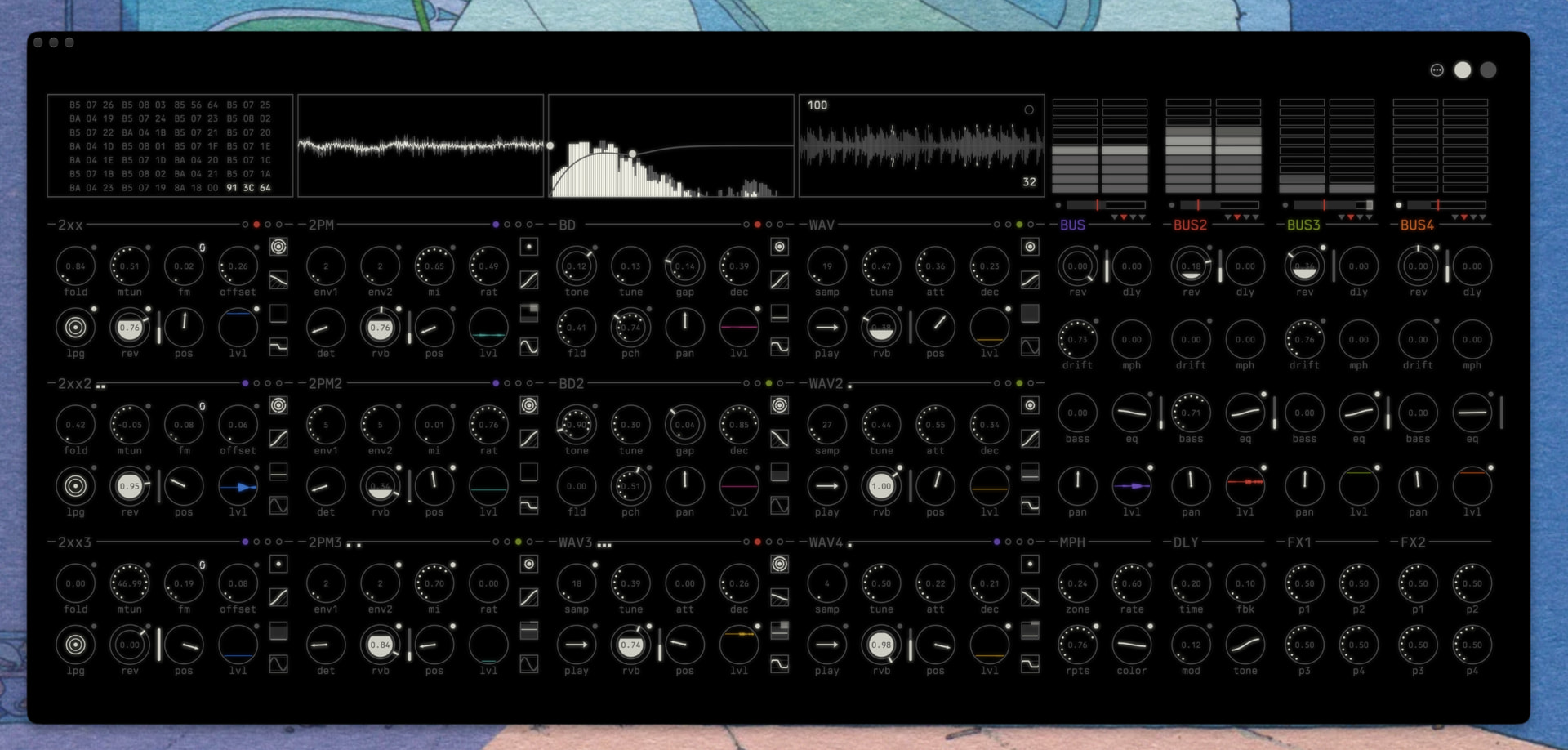
I agree completely. I’ve spent some time building myself a companion application with the idea of using the 8 assign knobs across a few sound source types and busses. Having a stable and shared interface of just these 8 controls really does help with muscle memory. A second page of 8 could expand the idea a lot.
Would be incredible if ASSIGN knobs would update their values on midi in!
Possible workaround for you if you don’t use dual projects:
use the second project as control surface
you have 16 tracks x 8 knobs
you can save and load init projects (knobs at 0) as well as preset projects (with values already dialed in)
so you can have multiple control states ready for recall for multiple synths
the limitation is 1 synth per project, but you could fit 2 or 3 across all the 16 tracks if you map only the essential controllers
you could use fixed track assignments across synths and put the labels on Hapax panel , i.e. track 1,2,3 = osc 1,2,3, track 4 = mixer etc.
I haven’t tested it yet, I am just typing this as it occurred to me right now.
Potential breaking point for recall is if Hapax or synth or anything in between won’t handle the initial burst flood of all 128 values on a single channel and drops some of those.
The hands on live control should be working fine though.
squarp actually does keep track of how many requests they log for similar features so there is merit to filling out the request form even if the request has been logged. also every time i make a unique request i repeat my previous requests which has seemed to work honestly. the features i want are being added anyway. ymmv
squarp did say specifically to use the form and / or use mentions. i see they have added the ‘me too’ button on requests as well.
I actually thought about this myself: A open source hw groovebox addon to the hapax. Based around two RP5 compute module sitting on a board with a gigabit ethernet switch, so multiple compute modules can use ethernet midi and audio to talk to each other, while also beeing interconnected by a fpga switch, which would allow dsp code to be run, and can act as link between multiple compute modules.
The interface would be hapax via USB, with custom controller scripts on the pi , interfacing the audio application. One compute module runs the groovebox, the other can host plugins, or do visuals.
Audio out is ADAT, so multichannel audio can be used with a standard audio interface. The visualization is either via a standard remote tablet, or an hdmi port interfacing the groovebox. With that existing hw can be reused, and only central low latency hardware can be build. Cost is about 200$ - design around daughter boards, which allows parts to be easy replaced, or user serviced. This would cut down electronic waste quiete a bitt if the plattform is modularized, and expandable.